Choosing a new furnace involves more than comparing brands, prices, and energy efficiency ratings. One of the most important decisions is determining the right heating capacity for your home. A furnace that’s too small may struggle during Vaughan’s coldest winter days, while an oversized system can lead to short cycling, inconsistent temperatures, and unnecessary energy consumption.
If you’re planning a furnace installation in Vaughan, understanding how furnace sizing works can help you make a more informed investment. Factors such as square footage, insulation, window efficiency, and your home’s layout all influence the amount of heat your property needs.
This furnace sizing guide explains how heating capacity is calculated, why proper sizing matters, and how professional assessments help homeowners choose efficient, reliable heating systems.
Key Takeaways: Choosing the Right Furnace Size
- Square footage is only the starting point. Homes of similar sizes can require different furnace capacities depending on insulation, windows, layout, and air leakage.
- BTUs measure heating capacity. Furnace ratings indicate how much heat a system consumes or produces per hour, but input and output BTUs are not the same.
- Bigger isn’t necessarily better. An oversized furnace may heat rooms too quickly, causing short cycling and uncomfortable temperature fluctuations.
- Heat-loss calculations improve accuracy. Professional sizing assessments account for how much heat a home loses during cold weather.
- Proper sizing supports long-term efficiency. A correctly selected furnace can provide consistent temperatures, dependable operation, and better use of energy throughout Ontario’s heating season.
Why Furnace Size Matters for Your Home
A furnace’s primary purpose is to replace the heat your home loses during colder weather. When outdoor temperatures fall, heat escapes through windows, walls, ceilings, foundations, and areas where outside air enters the building.
The furnace must produce enough heat to offset those losses and maintain a comfortable indoor temperature.
However, choosing a system with more heating capacity than necessary doesn’t automatically improve performance.
An oversized furnace can reach the thermostat’s target temperature too quickly, causing frequent heating cycles. An undersized furnace, on the other hand, may run for extended periods without providing sufficient heat during particularly cold weather.
The objective is to match furnace output to the home’s heating requirements rather than selecting the largest available unit.
What Happens When Your Furnace Is Properly Sized?
A properly sized furnace can maintain more consistent indoor temperatures without excessive cycling or unnecessary strain on heating components.
Some of the most important benefits include:
- Consistent comfort: More balanced heating throughout the home.
- Energy efficiency: Heating output better matched to actual demand.
- Reduced equipment strain: Fewer unnecessary starts and stops caused by excessive capacity.
- Long-term reliability: Appropriate operation that helps prevent avoidable wear.
- Better value: Avoiding unnecessary spending on equipment capacity your home doesn’t need.
Correct sizing also helps homeowners make better decisions when comparing different furnace models and installation quotes.
Understanding Furnace BTUs and Heating Capacity
Furnace capacity is generally measured in British Thermal Units per hour (BTU/h). This measurement helps describe how much heating energy a furnace uses or delivers.
When researching furnace options, homeowners frequently encounter models rated at 40,000, 60,000, 80,000, or 100,000 BTU/h.
However, these figures often refer to the furnace’s fuel input rather than the usable heat delivered into the home’s air distribution system.
Furnace Input BTUs vs. Output BTUs
The distinction between input and output matters because no gas furnace converts every unit of fuel energy into usable heat.
A furnace’s Annual Fuel Utilization Efficiency (AFUE) rating indicates its seasonal fuel-to-heat conversion efficiency under standardized conditions.
For example, a furnace with an 80,000 BTU/h input rating and 96% AFUE delivers approximately 76,800 BTU/h of heating output under rated conditions.
| Furnace Input | AFUE Rating | Approximate Heating Output |
| 40,000 BTU/h | 96% | 38,400 BTU/h |
| 60,000 BTU/h | 96% | 57,600 BTU/h |
| 80,000 BTU/h | 96% | 76,800 BTU/h |
| 100,000 BTU/h | 96% | 96,000 BTU/h |
Figures are illustrative calculations. Actual furnace performance depends on the manufacturer’s rated output, operating conditions, and system configuration.
Understanding this difference helps homeowners compare heating equipment more accurately.
How Many BTUs Does Your Home Need?
The number of BTUs required depends on how much heat your home loses during winter.
Although online furnace sizing calculators sometimes estimate capacity based on square footage, these formulas cannot account for every important characteristic of a property.
For example, two 2,000-square-foot houses in Vaughan may have very different heating requirements.
A newer home with high-performance windows, improved insulation, and limited air leakage may need substantially less heating capacity than an older house of the same size with drafty windows and insufficient insulation.
That’s why square footage estimates should be treated as preliminary guidance rather than a final equipment recommendation.
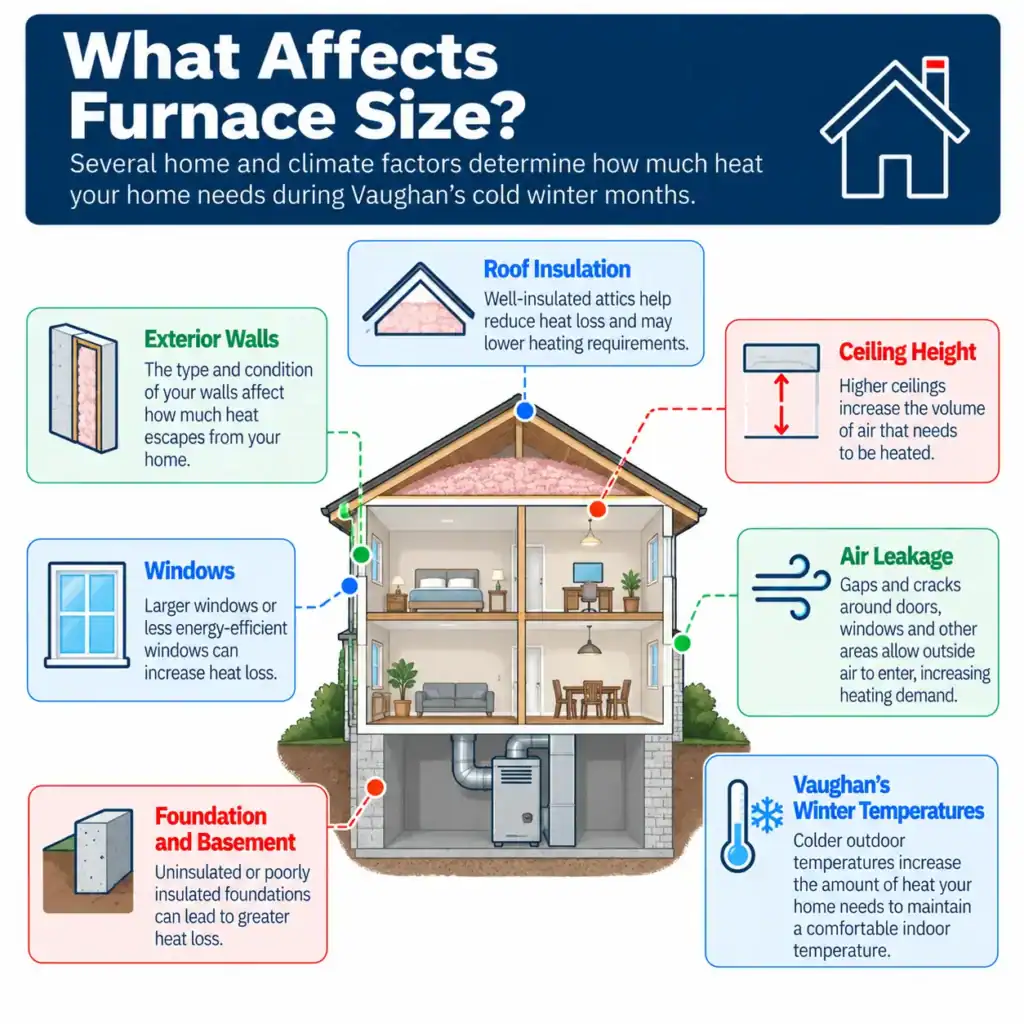
Factors That Determine the Right Furnace Size
Several characteristics influence how quickly a home loses heat and how much heating capacity it needs.
An accurate assessment considers these factors together rather than relying on a single measurement.
1. Home Size and Ceiling Height
Larger homes often require more heating capacity because they have more space to maintain at comfortable temperatures.
However, square footage alone doesn’t account for ceiling height, building shape, or exposed exterior surfaces.
A home with vaulted ceilings or large open living areas may have different heating demands than a property with a more compact layout.
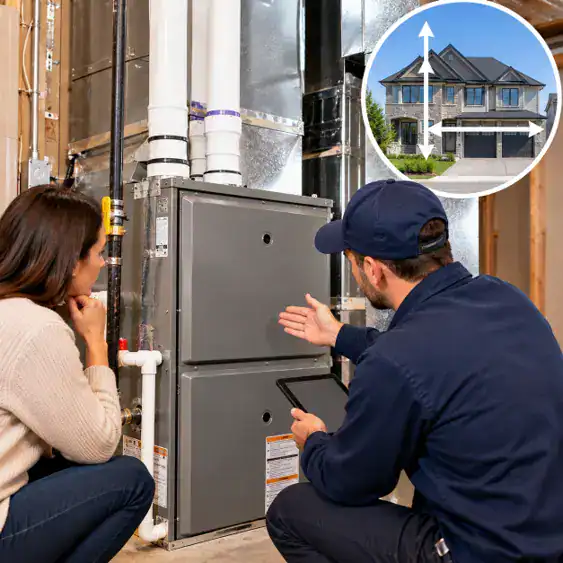
A professional assessment evaluates the building’s actual dimensions and construction characteristics to estimate its heating requirements.
2. Insulation and Air Leakage
Insulation plays an important role in reducing heat loss through walls, ceilings, floors, and other parts of the building envelope.
Well-insulated homes generally require less heating energy to maintain comfortable temperatures.
Air leakage also matters. Gaps around doors, windows, attic openings, and other building penetrations can allow heated indoor air to escape while colder outdoor air enters.
For homeowners planning a new furnace installation in Vaughan, improvements to insulation and air sealing may affect the capacity required.
Installing a furnace before considering planned energy-efficiency upgrades could result in equipment that’s larger than the home will eventually need.
3. Window Size and Energy Performance
Windows can be a significant source of heat loss, particularly in older homes with inefficient glazing or poorly sealed frames.
The number, size, and thermal performance of windows all influence heating requirements.
For instance, a property with large windows and extensive exterior exposure may lose more heat than a similarly sized house with smaller, energy-efficient windows.
Modern double- or triple-glazed windows can help reduce heat transfer, depending on their specifications and installation quality.
4. Home Layout and Room Distribution
The way rooms are arranged can affect how efficiently warm air circulates throughout a home.
Multi-storey houses, finished basements, open-concept areas, and rooms located far from the furnace may experience different heating conditions.
While the building’s overall heat loss determines required heating capacity, room-by-room heating needs and ductwork design influence how that heat should be distributed.
This is especially important for homeowners experiencing persistent cold spots or uneven temperatures.
5. Vaughan’s Winter Climate
Local outdoor temperatures are a key consideration when calculating heating requirements.
A furnace must provide sufficient heating output when outdoor temperatures approach the design conditions used for the area.
Vaughan experiences cold Ontario winters, making reliable heating essential for residential comfort. Professional sizing calculations incorporate relevant local climate data rather than assuming that homes in every region of Canada require the same heating capacity.
Not Sure What Furnace Size Your Home Needs?
ALP Heating Services helps homeowners in Vaughan evaluate their residential heating requirements and compare suitable furnace options. Get professional guidance before investing in a new heating system.
BUTTON CTA: [REQUEST INSTALLATION QUOTE]
How to Tell if Your Furnace Is Too Big or Too Small
An incorrectly sized furnace can affect heating performance, energy consumption, and comfort.
While these problems can also result from maintenance issues or faulty components, certain symptoms may indicate that the existing system isn’t properly matched to your home.
Signs Your Furnace May Be Oversized
An oversized furnace produces more heat than the home requires under many operating conditions.
As a result, it may reach the thermostat’s target temperature quickly and shut off before completing an appropriate heating cycle.
Common warning signs include:
- Frequent starting and stopping, also known as short cycling
- Noticeable temperature fluctuations between cycles
- Some rooms becoming too warm while others remain cooler
- Excessive airflow noise during operation
- Increased wear associated with repeated equipment cycling
However, short cycling doesn’t always mean a furnace is oversized. Dirty filters, airflow restrictions, thermostat issues, and overheating safety controls can produce similar symptoms.
A professional diagnosis is necessary before concluding that replacement or resizing is required.
Signs Your Furnace May Be Undersized
An undersized furnace may struggle to replace heat as quickly as the home loses it.
During especially cold weather, the system might run continuously or for extended periods without reaching the desired thermostat temperature.
Potential signs include:
- Difficulty maintaining comfortable temperatures during cold weather
- Long heating cycles without reaching the thermostat setting
- Rooms that remain consistently colder than expected
- Limited heating recovery after temperature setbacks
Before assuming insufficient furnace capacity, a technician should evaluate airflow, ductwork, thermostat operation, and equipment condition.
Can an Incorrectly Sized Furnace Increase Energy Bills?
Yes. A poorly sized furnace may operate inefficiently or contribute to heating problems that increase energy consumption.
However, equipment size is only one factor affecting monthly heating expenses.
Insulation, air leakage, thermostat settings, furnace efficiency, and gas rates also influence energy bills.
Correct sizing should therefore be considered alongside the home’s overall energy performance.
| Furnace Sizing Issue | Possible Symptoms | Recommended Action |
| Oversized furnace | Short cycling, temperature fluctuations, airflow noise | Evaluate heating capacity and system operation |
| Undersized furnace | Extended operation, difficulty maintaining heat | Assess heating load and equipment output |
| Poorly balanced airflow | Hot and cold spots, weak airflow in some rooms | Inspect ductwork and airflow distribution |
| Properly sized furnace | More consistent heating and appropriate operating cycles | Continue regular maintenance |
Why Professional Heat-Loss Calculations Matter
A professional heat-loss calculation provides a more reliable method of determining furnace capacity than estimating BTUs from square footage alone.
In Canada, CSA F280 is a recognized standard for determining the required capacity of residential space heating and cooling equipment.
A heating-load assessment evaluates the amount of heat a building loses under specified winter design conditions.
What Does a Heat-Loss Assessment Include?
A detailed calculation considers multiple aspects of the property, including:
- Building dimensions: Floor area, ceiling heights, and exterior surfaces.
- Insulation levels: Thermal resistance in walls, ceilings, and other building components.
- Window and door performance: Heat transfer through glazing, frames, and openings.
- Air infiltration: Heat loss associated with outdoor air entering the home.
- Local design temperatures: Winter conditions relevant to the property’s location.
- Ventilation requirements: Additional heating demand associated with ventilation air.
The resulting calculation estimates the home’s design heating load.
That figure can then be used to select equipment with an appropriate heating output.
Why Replacing Your Furnace With the Same Size Isn’t Always Best
When replacing an existing furnace, it may seem easiest to purchase another unit with the same BTU rating.
However, the previous system may have been oversized or undersized from the beginning.
The home’s heating requirements may also have changed following renovations, window replacements, insulation improvements, or air-sealing upgrades.
For this reason, the existing furnace’s capacity should be treated as useful background information rather than definitive proof of the correct replacement size.
How Proper Sizing Supports More Reliable Installation
Accurate furnace sizing helps establish the foundation for successful installation.
Once the appropriate heating capacity is identified, the contractor can evaluate compatible furnace models, blower capabilities, and the existing air distribution system.
This allows the homeowner to compare equipment based on actual requirements rather than assumptions.
A properly completed sizing assessment can also help prevent unnecessary spending on excessive heating capacity.
Choosing a High-Efficiency Furnace for Your Home
After determining the appropriate furnace capacity, the next step is comparing equipment efficiency and comfort features.
Homeowners exploring high efficiency furnace installation in Toronto and surrounding GTA communities should consider how different models manage heating output, airflow, and temperature control.
A high-efficiency furnace can help reduce fuel consumption compared with older, less efficient equipment. However, its performance still depends on correct sizing and installation.
Single-Stage, Two-Stage, and Modulating Furnaces
Different furnace technologies regulate heating output in different ways.
| Furnace Type | How It Operates | Main Consideration |
| Single-stage | Operates at one main heating output when the burner is on | Generally simpler and less expensive |
| Two-stage | Uses lower and higher heating output levels | Can provide more consistent comfort during varying heating demand |
| Modulating | Adjusts heating output across a range | Offers more precise temperature control |
Two-stage and modulating systems can adjust their heating output to better match changing conditions.
For example, a two-stage furnace may operate at a lower heating level during milder weather, switching to higher output when additional heat is required.
This flexibility can improve comfort, but it doesn’t eliminate the need for proper equipment sizing.
Why Furnace Efficiency and Size Work Together
Furnace efficiency describes how effectively equipment converts fuel into heat. Furnace capacity describes how much heat it can produce.
These are related but separate characteristics.
A highly efficient furnace with excessive heating capacity may still experience short cycling, while a properly sized system with inefficient equipment may consume more fuel than necessary.
Homeowners should therefore compare both the rated heating output and AFUE efficiency when selecting a furnace.
Don’t Overlook Your Existing Ductwork
The furnace and ductwork must work together to distribute heated air throughout the home.
If existing ducts cannot accommodate the airflow required by the new equipment, the system may experience excessive static pressure, restricted airflow, or uneven heating.
A qualified HVAC professional can assess whether the ductwork is compatible with the recommended furnace.
This is particularly important when upgrading to equipment with different blower characteristics or heating capacities.
Find the Right Furnace with ALP Heating Services
Choosing the right furnace size is one of the most important steps toward dependable, efficient home heating.
Although square footage provides a useful starting point, accurate furnace selection requires a closer look at insulation, air leakage, windows, layout, ductwork, and Vaughan’s winter conditions.
A furnace that’s too large can create unnecessary cycling and temperature fluctuations. One that’s too small may struggle to maintain comfortable temperatures when heating demand increases.
Professional sizing helps homeowners avoid these problems and select equipment that meets their home’s actual requirements.
ALP Heating Services provides residential furnace installation and replacement services throughout Vaughan and the Greater Toronto Area. Its qualified technicians can evaluate heating needs, review equipment compatibility, and help homeowners compare energy-efficient furnace options suited to their properties.
Ready to Choose the Right Furnace for Your Vaughan Home?
Whether you’re replacing an aging heating system or considering a high-efficiency upgrade, ALP Heating Services can help you explore furnace installation options based on your home’s heating requirements.
BUTTON CTA: [REQUEST INSTALLATION QUOTE]
Call (647) 972-8714 to discuss residential furnace installation in Vaughan and surrounding GTA communities.
Frequently Asked Questions About Furnace Sizing and Installation
1. How many BTUs does a furnace need for a 2,000-square-foot home?
A 2,000-square-foot home doesn’t have one universal BTU requirement. Its heating needs depend on insulation, air leakage, windows, layout, and local winter temperatures. For example, a well-insulated home may require considerably less heating capacity than an older, draftier property of the same size. A professional heat-loss calculation provides a more accurate recommendation than square footage estimates.
2. How does a home’s insulation affect the required furnace size?
Better insulation reduces heat loss through walls, ceilings, and other building surfaces, which can lower the heating capacity a home requires. Poor insulation allows heat to escape more quickly, increasing heating demand. When choosing a furnace, technicians should evaluate insulation levels alongside air leakage and window performance to determine an appropriate equipment size.
3. What is the difference between furnace input BTUs and heating output BTUs?
Input BTUs measure the amount of fuel energy a furnace consumes per hour, while output BTUs represent the heat delivered by the equipment. For example, an 80,000 BTU/h input furnace rated at 96% AFUE provides approximately 76,800 BTU/h of heating output under rated conditions. Heating output is the more relevant figure when comparing furnace capacity with a home’s calculated heating requirements.
4. Can an oversized furnace cause uneven heating or short cycling?
Yes. An oversized furnace can heat a home too quickly, causing the thermostat to shut it off before an appropriate heating cycle is completed. This short cycling can contribute to temperature fluctuations, uneven comfort, and additional component wear. However, similar symptoms can result from airflow restrictions or control problems, so professional diagnosis is important.
5. Why is a heat-loss calculation important before furnace installation in Vaughan?
A heat-loss calculation estimates how much heating capacity a Vaughan home needs during winter design conditions. It considers building dimensions, insulation, windows, air leakage, and local climate data. This helps prevent overestimating or underestimating the required furnace capacity and supports more informed equipment selection before installation.
6. How does ALP Heating help Vaughan homeowners select the right furnace size?
ALP Heating helps Vaughan homeowners evaluate their heating requirements before choosing a replacement furnace. Its residential installation guidance considers factors such as home size, insulation, existing heating equipment, and system compatibility. By discussing these characteristics and available furnace options, ALP Heating can help homeowners make more informed decisions about heating capacity, efficiency, and comfort.
7. Can ALP Heating assess whether an existing furnace is incorrectly sized?
ALP Heating provides residential furnace inspections and installation assessments that can help identify potential sizing or performance problems. Homeowners experiencing short cycling, inconsistent temperatures, or difficulty heating their property can request an evaluation. Technicians can review the furnace’s operation, equipment capacity, and related heating system conditions to determine whether sizing may be contributing to the issue.
8. Does ALP Heating offer high-efficiency furnace installation in Toronto and across the GTA?
Yes. ALP Heating provides high-efficiency residential furnace installation in Toronto, Vaughan, and surrounding communities throughout the Greater Toronto Area. The company installs energy-efficient gas heating equipment and helps homeowners compare available systems based on their heating needs, efficiency preferences, and budgets. Service availability can be confirmed when requesting an installation quote.
9. Can ALP Heating recommend furnace options based on a home’s layout and heating needs?
Yes. ALP Heating helps homeowners explore furnace options suited to their property’s layout, heating requirements, and existing HVAC infrastructure. Considerations may include floor area, insulation, room distribution, ductwork compatibility, and preferred comfort features. This allows homeowners to compare equipment based on their home’s practical needs rather than choosing solely by brand or furnace capacity.
10. Why should homeowners consult ALP Heating before choosing a furnace size in Vaughan?
Consulting ALP Heating before purchasing a furnace can help Vaughan homeowners avoid selecting equipment that doesn’t suit their home’s heating requirements. Professional installation guidance can identify important considerations involving furnace capacity, efficiency, airflow, and existing system compatibility. This supports a more informed investment in reliable residential heating and long-term comfort.